
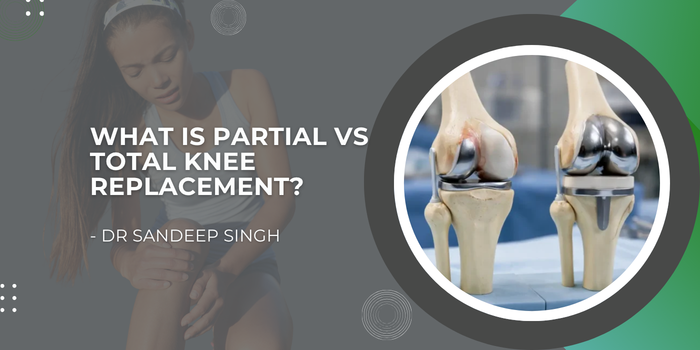
Knee replacement surgery is a common procedure which helps patients who suffer from extreme knee pain that results from arthritis or injuries or the breakdown of their knee joints. The procedure uses artificial parts to replace damaged joint surfaces which create better joint movement and improved patient mobility. Most patients notice significant improvement in pain and function within the first year after surgery. Some people keep experiencing knee replacement pain after 1 year.
People should not dismiss their ongoing pain because it can happen when they push their body too hard after experiencing muscle strain. Patients can learn about their pain origins which enables them to obtain medical help before their condition worsens. Dr. Sandeep Singh who works as an Orthopaedic Doctor in Bhubaneshwar can help establish your medical condition and deliver the necessary treatment.
What is Partial vs Total Knee Replacement?
Partial knee replacement fixes one damaged compartment. Total knee replacement swaps out all three with metal and plastic parts.
| Aspect | Partial Knee Replacement | Total Knee Replacement |
| Scope | One of three compartments resurfaced | Femur tibia and kneecap all replaced |
| Incision | Smaller cut less blood loss | Bigger cut more tissue exposed |
| Recovery | Walking within hours discharge in 1 to 2 days | Hospital stay of 2 to 3 days |
| Longevity | Implant lasts 10 to 15 years | Implant lasts 20 to 25 years |
| Indication | Isolated arthritis in one compartment | Widespread arthritis or joint deformity |
| Feel | Natural ligaments retained more normal sensation | Full prosthetic feel with restored alignment |
Want more detail? Read about lateral unicompartmental replacement for deeper insight.
How Do Surgeons Decide Between Partial and Total?
The call comes down to damage spread ligament health,patient age and how the knee lines up. Imaging confirms the rest.
- Damage extent: Partial works if arthritis sits in one compartment only. Spread it across the joint and total becomes the safer pick for lasting results
- Ligament health: Partial needs a solid ACL and MCL to stay stable whereas total doesn’t. Weak ligaments? Partial is off the table straight away
- Patient age: Younger active patients usually do better with partial since recovery’s faster. Older folks with advanced wear and tear tend to need total
- Knee alignment: Bowing or severe deformity? Skip partial. Total handles the correction far better and restores alignment in complex joint cases
For an in depth look at recovery check total knee arthroplasty explained.
What are the Recovery Timelines for Each Surgery?
Recovery speed isn’t fixed. It shifts with surgery type age overall health and how seriously you stick to physio.
- Walking: Partial patients are usually up and moving within a few hours. Total replacement takes a day or two before walking kicks in
- Discharge: Partial surgery sends you home in 1 to 2 days while total needs 2 to 3 days of hospital observation before going home safely
- Driving: Back behind the wheel in about 2 weeks after partial. Total replacement? You’re looking at 4 to 6 weeks minimum before driving is safe
- Full recovery: Partial patients bounce back in roughly 6 weeks. Total takes 3 to 6 months of consistent physio before full mobility comes back
Why Choose Dr. Sandeep Singh for Knee Replacement in Bhubaneswar?
Dr. Sandeep Singh brings 15 years of experience as a consultant orthopedic surgeon.His qualifications include MS(Ortho)MRCS Glasgow MRCS UK FRCS London in Primary and Revision Joint Replacement plus a Fellowship in Sports Injury from the UK.He trained under Prof.Fares Haddad and works with robotic and arthroscopic techniques.
He heads the Sports Injury and Rehabilitation Department at CARE Super Specialty Hospital. Pioneered FASTTRACK joint replacement across Odisha. And it’s the only centre in the state where partial knee patients
If you notice unusual symptoms, seek advice from a trusted Orthopaedic Doctor in Bhubaneshwar without delay.
Frequently Asked Questions
1. Which surgery recovers faster, partial or total?
Partial knee replacement has a faster recovery with many patients walking the same day
2. Can a partial knee replacement become total later?
Yes if more compartments deteriorate conversion to total knee replacement is possible
3. Is partial knee replacement less painful?
4. How long do partial and total implants last?