
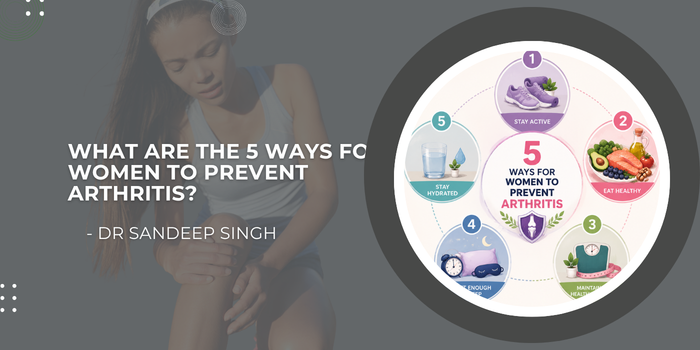
Women can significantly reduce their arthritis risk by maintaining a healthy weight, staying active, protecting joints from injury, eating an anti-inflammatory diet, and quitting smoking. These aren’t vague wellness tips; they directly cut the physical stress and chronic inflammation that push joints toward arthritis, especially in women past 40.
According to Dr. Sandeep Singh, orthopedic doctor in Bhubaneswar, “Arthritis in women is not inevitable. The lifestyle choices made in your 30s and 40s directly determine how your joints hold up in the decades ahead. Prevention is always easier than treatment.”
Want to protect your joints long-term? Book an Appointment
What Are the 5 Lifestyle Changes That Help Women Prevent Arthritis?
Arthritis doesn’t arrive suddenly. It builds over years of small injuries ignored, weight gained gradually, inflammation that never fully settled. By the time symptoms show up, the joint has been under stress for a long time. These five habits target that slow build directly.
Watch your weight closely. Every extra kilogram puts roughly four times that load on the knee with each step. Women are already at higher biological risk than men carrying excess weight accelerates cartilage breakdown faster than almost any other single factor.
Move, but choose the right kind. Swimming, walking, cycling these nourish cartilage without the impact damage that running or jumping creates. Resting a sore joint feels right instinctively. Often it just makes stiffness worse.
Quitting smoking matters more than most expect. Tobacco raises systemic inflammation throughout the body, cuts blood flow to joint tissue, and has a documented link to higher rheumatoid arthritis rates in women specifically.
Protect joints before they complain. Supportive footwear, proper technique during lifting or exercise, not pushing through persistent pain these prevent micro-injuries that quietly accumulate over decades. An ankle sprain badly healed at 35 can become ankle arthritis at 55.
Diet gives more control than people realise. Omega-3s from fish, flaxseed, walnuts. Leafy greens. Berries. Whole grains. These reduce the background inflammation that erodes cartilage slowly. Processed food and refined sugar push in the opposite direction not dramatically, but consistently enough to matter.
Find out more about how joint conditions are managed through arthroscopic sports surgery.
What Other Factors Increase Arthritis Risk in Women Specifically?
Lifestyle changes get most of the attention in arthritis prevention conversations. They deserve it. But women also carry a set of biological risks that are worth knowing about not because they’re fixed, but because understanding them changes how you approach prevention.
Oestrogen is one of the less-discussed joint protectors in the body. It has a direct effect on cartilage health. After menopause, when levels fall, joint inflammation rises which is exactly why arthritis diagnoses in women jump sharply after 50. It isn’t a coincidence.
Flexibility, interestingly, isn’t always an advantage. Women tend toward greater joint hypermobility than men. More flexible joints are also less stable joints. That instability leads to repeated small injuries over years of micro-traumas that individually seem minor but collectively degrade cartilage.
Bone density is another piece of this. Women lose it faster than men, especially post-menopause. When the bone around a joint weakens, more load transfers to the cartilage. Cartilage wasn’t designed to absorb that extra stress indefinitely.
For a closer look at how knee arthritis develops and progresses, this piece on osteoarthritis of the knee covers it well.
Why Choose Dr. Sandeep Singh for Arthritis and Joint Care?
Some surgeons operate. Fewer build departments. Dr. Sandeep Singh built the Sports Injury and Rehabilitation Department at CARE Super Specialty Hospital Bhubaneswar the first of its kind in Odisha alongside a clinical career spanning fifteen years and qualifications across two countries. MS Ortho, MRCS Glasgow, MRCS UK, FRCS London in Primary and Revision Joint Replacement, Sports Injury Fellowship under Prof. Fares Haddad. The treatment plans here don’t just address the joint in isolation. Muscle function, long-term prevention, and rehabilitation are mapped together from the start. Call +91 8658044823 to book a consultation.
Frequently Asked Questions
Are women more likely to develop arthritis than men?
They are, by a significant margin. Both osteoarthritis and rheumatoid arthritis affect women at higher rates, and the gap widens after menopause when oestrogen levels fall and cartilage loses a key protective factor.
At what age should women start preventing arthritis?
The 30s and 40s are the most impactful window habits built then carry forward into the higher-risk decades. That said, starting later still slows progression meaningfully even in those who already have early symptoms.
Can diet alone prevent arthritis in women?
Not reliably on its own. Diet is one strong lever among several. Weight management, consistent movement, and joint protection all need to work together. Relying on diet alone leaves the other factors unaddressed.
Is arthritis hereditary in women?
Family history raises risk, particularly for rheumatoid arthritis. But it isn’t destiny. Lifestyle changes carry enough preventive weight that having a genetic predisposition is a reason to act earlier, not a reason to accept the outcome.
Disclaimer
This blog is for educational purposes only and is not a substitute for professional medical advice.