
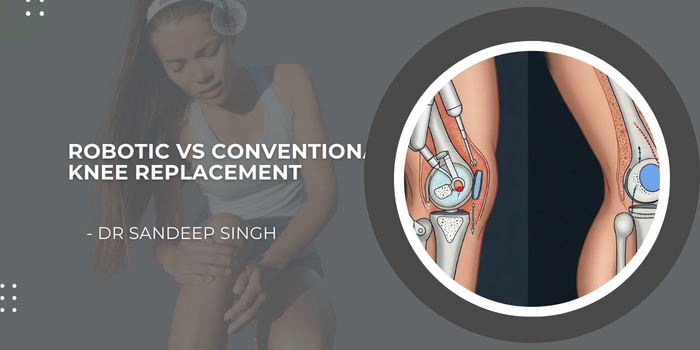
Robotic and conventional knee replacements achieve the same goal but through different methods. Conventional surgery relies on the surgeon’s visual judgment and manual skill to make bone cuts and position the implant. Robotic surgery adds a layer of 3D planning software and a robotic arm to that process, allowing for more precise implant alignment and more accurate bone cuts before a single incision is made. The core procedure is the same. What changes is the degree of planning precision and intraoperative control.
According to Dr. Sandeep Singh, orthopedic doctor in Bhubaneswar, “Both approaches work. The difference is in how much margin for error each one carries. Robotic assistance does not replace surgical experience. It gives an experienced surgeon better tools to work with, and that shows up in alignment accuracy and long-term implant performance.”
|
Robotic Knee Replacement |
Conventional Knee Replacement |
|
|
Planning |
3D preoperative mapping |
Manual assessment and X-rays |
|
Bone cuts |
Robotic arm guided |
Surgeon hand guided |
|
Alignment accuracy |
Higher precision |
Dependent on surgeon skill |
|
Recovery speed |
Generally faster |
Standard timeline |
|
Cost |
Higher |
Lower |
How Does Robotic Knee Replacement Work Differently From Conventional Surgery?
The difference is not in the implant. Both procedures use the same prosthetic components. The difference is entirely in how those components are placed.
Planning starts before the patient enters the theatre. In robotic surgery, a CT scan taken beforehand is used to build a three-dimensional model of the patient’s specific knee anatomy. The surgeon plans the exact implant size, position, and alignment on that digital model before operating. Conventional surgery works from X-rays and intraoperative visual assessment. Both can produce excellent results, but one leaves less to real-time estimation.
The robotic arm does not perform the surgery independently. This is a common misunderstanding worth clearing up early. The surgeon controls the procedure throughout. What the robotic arm does is restrict movement outside the pre-planned zone, making it physically difficult to cut bone in the wrong place. It acts as a boundary, not a replacement for surgical decision making.
Soft tissue balancing gets more attention in robotic cases. Getting the ligaments around a replaced knee balanced correctly affects how the joint feels and moves for years afterward. Robotic systems provide real-time feedback on soft tissue tension during surgery, allowing the surgeon to adjust before closing. Conventional surgery relies on tactile feel and experience to achieve the same result.
The incision size and anaesthesia requirements are similar in both. Robotic surgery does not mean smaller cuts or less anaesthesia. The operative steps are largely the same. The precision difference lies in what happens within those steps, particularly during bone preparation and implant positioning .
Recovery tends to move faster after robotic procedures, though individual variation exists. More accurate implant placement means less post-operative inflammation from compensatory stress on surrounding tissue. Patients frequently report getting through early physiotherapy milestones more comfortably. That said, conventional knee replacement done by a skilled surgeon produces excellent outcomes too, and recovery timelines overlap considerably between the two approaches.
Learn more about what modern knee replacement surgery involves and what to expect as a patient.
Who Is a Better Candidate for Robotic Versus Conventional Knee Replacement?
Not every patient needs the robotic approach. And not every hospital offers it. Understanding which factors push a case toward one method or the other helps patients ask better questions during consultation.
Robotic surgery makes the most difference in complex cases. Patients with significant deformity, previous surgeries around the knee, unusual anatomy, or very high activity expectations benefit most from the additional precision robotic planning provides. When anatomy is straightforward and the surgeon is highly experienced, conventional surgery closes the gap considerably.
Younger patients have more to gain from alignment precision. A well aligned implant wears more evenly and lasts longer. For a 55 year old expecting 25 or more years from their replacement, getting alignment right at the time of surgery is worth more than it is for a 72 year old with lower functional demands.
Conventional surgery remains the global standard for good reason. The overwhelming majority of successful knee replacements performed worldwide use conventional technique. Experienced surgeons achieve excellent alignment without robotic assistance. The technology adds a margin of accuracy, not a fundamental capability that did not exist before.
Cost and availability shape the decision in practice. Robotic systems require significant hospital investment and not all centres have them. For patients where cost is a significant constraint, conventional surgery by a skilled and experienced surgeon is a well validated alternative with decades of outcomes data behind it.
Revision surgery and bilateral replacements often benefit from robotic planning. When both knees are being replaced simultaneously, or when a previous replacement is being revised, the additional data from preoperative 3D mapping helps the surgeon navigate altered anatomy with greater confidence.
For more context on the conditions that typically lead to knee replacement, the piece on osteoarthritis and RA explains how joint disease progresses toward surgical intervention.
Why Choose Dr. Sandeep Singh for Knee Replacement in Bhubaneswar?
Robotic assisted knee replacement in Odisha did not exist before Dr. Sandeep Singh brought it to CARE Super Specialty Hospital Bhubaneswar. Fifteen years of orthopaedic practice, MS Ortho, MRCS Glasgow, MRCS UK, FRCS London in Primary and Revision Joint Replacement, and a Fellowship in Sports Injury under Prof. Fares Haddad in the UK. He heads Sports Injury and Rehabilitation at CARE and pioneered FASTTRACK joint replacement in Odisha, where patients walk within hours of surgery. Whether the case calls for robotic or conventional technique, the planning, the execution, and the recovery support are built around what each individual patient actually needs. Call +91 8658044823 to book a consultation.
Frequently Asked Questions
- Is robotic knee replacement better than conventional?
For many patients, particularly younger or more active ones, robotic surgery offers meaningful advantages in alignment precision and potentially longer implant life. For straightforward cases handled by an experienced conventional surgeon, the outcome difference narrows considerably. - Is robotic knee replacement more painful?
The procedure itself involves similar discomfort levels to conventional surgery. Post-operative pain often resolves somewhat faster in robotic cases because accurate implant placement reduces compensatory stress on surrounding tissue. - How much more does robotic knee replacement cost?
Costs vary by hospital and city. Robotic procedures are generally more expensive due to the technology involved. The additional cost should be weighed against the potential benefit of improved alignment accuracy and longevity, particularly for younger patients. - Can all knee replacement patients use robotic surgery?
Most can, but access depends on which hospitals in the area offer the technology. Medical factors rarely exclude patients from robotic surgery. Availability and cost are the more common limiting factors in practice.
References
Robotic assisted vs conventional total knee arthroplasty: alignment accuracy and clinical outcomes — https://pmc.ncbi.nlm.nih.gov/articles/PMC11918693/
Robotic assisted vs conventional total knee arthroplasty: systematic review and meta-analysis of RCTs — https://www.ncbi.nlm.nih.gov/pmc/articles/PMC10980635/
Disclaimer:
This blog is for educational purposes only and is not a substitute for professional medical advice.