
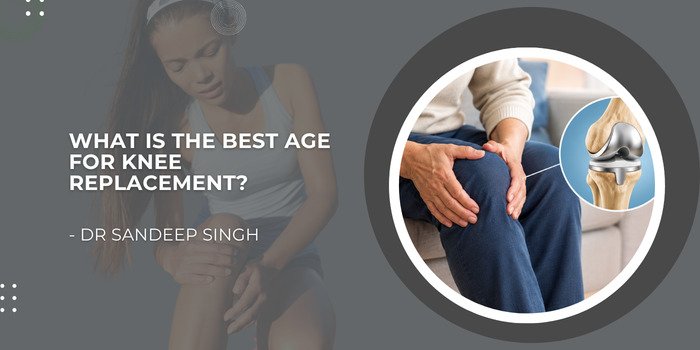
Yes, especially with rheumatoid arthritis or an old injuryStruggling with knee pain that won’t ease up? Most people who get a knee replaced are somewhere between 60 and 80. The average lands around 65 or 70. But age isn’t really the deciding factor here. Joint damage and how much it’s affecting your daily life carry far more weight. Some younger patients with rheumatoid arthritis or an old injury need the surgery well before 60. And there’s no strict upper limit either. Fitness for surgery is what settles that, not the number on your ID.
According to Dr. Sandeep Singh, one of the best orthopedic doctor in Bhubaneswar, “Patients wait for a number that doesn’t exist. I look at the joint. Not the calendar. If pain is stealing your sleep or making stairs difficult, it’s time to have the joint properly evaluated.”
Struggling with knee pain that won’t ease up? Book an Appointment with Dr. Sandeep Singh to find out what’s actually causing it.
Does Age Really Decide When You Need Knee Replacement?
Not by itself. Surgeons look at joint damage and daily function before anything else.
Joint damage: Bone-on-bone contact on an X-ray settles this faster than age ever could.
Daily function: Trouble with stairs. Broken sleep. Struggling to stand from a chair. These say more than your birth year.
Health status: Diabetes, heart issues and weight affect surgical fitness more than age does.
What age actually decides: Healing speed and implant lifespan. Not whether you qualify.
Getting this timing right also matters even after surgery. Understanding why knee replacement pain after 1 year happens can help you set the right expectations before the damage forces a rushed decision.
Is There an Age Limit for Knee Replacement?
Not really. Fitness for surgery matters more than a cutoff number.
Younger patients: Rheumatoid arthritis or a post-injury knee can force this decision decades early.
Older patients: Plenty of people in their 80s recover well, as long as the heart and lungs are up for it.
Revision risk: Operate too young and a second surgery becomes likely later. Wait too long and other health conditions start complicating things.
The actual cutoff: Overall health. Age barely enters the picture.
If rheumatoid arthritis is causing joint damage, our piece on is part of your situation, our piece on osteoarthritis vs rheumatoid arthritis explains why RA often pushes the need for knee replacement earlier.
Why Choose Dr. Sandeep Singh for Knee Replacement?
Dr. Sandeep Singh has over 15 years of experience in joint replacement and fellowships in robotic arthroplasty and lower limb surgery from the UK. He doesn’t work off age charts. Every case gets looked at on its own terms, which is what makes the timing call accurate instead of a guess.
His approach centres on function over fixed age brackets. Outcomes get matched to how you actually live, not how old you are. Call 8658044823 to book a consultation and get a straight answer on timing.
Frequently Asked Questions
- What is the best age for knee replacement?
Usually 60 to 80. Joint damage decides more than age does.
- Is there an age limit for knee replacement?
No fixed limit exists. Overall health decides surgical fitness. - Can someone under 60 need a knee replacement?
Yes, especially with rheumatoid arthritis or an old injury - Does age affect recovery time?
A little. Fitness and rehab effort matter more than age.
Disclaimer: This blog is for informational purposes only and is not a substitute for professional medical advice.
References
- NCBI PMC — Is there an optimal age for total knee arthroplasty? A systematic review: https://pmc.ncbi.nlm.nih.gov/articles/PMC7667791
- NCBI PMC — Younger age increases the risk of early prosthesis failure following primary total knee replacement: https://pmc.ncbi.nlm.nih.gov/articles/PMC2917562